

Saadat Hasan: The Man behind Manto
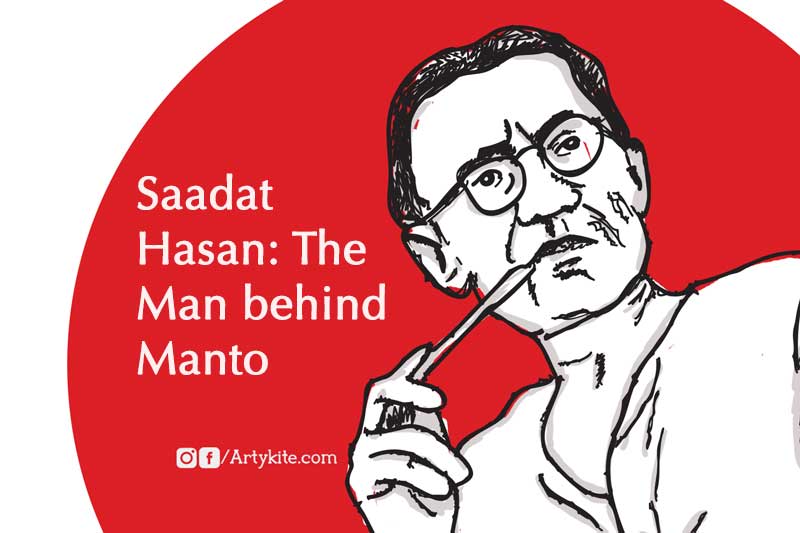
Here Manto lies buried—and buried in his breast are all the secrets of the art of storytelling – Saadat Hasan Manto.
This is the second part of our series on the life and works of Saadat Hasan Manto. You can read the first part here.
Saadat Hasan Manto, the greatest short story writer of India and Pakistan, has always fascinated Urdu literature lovers.
Some say his ability to depict the reality of society with ease was what captivated the reader, others believe it was the way he challenged and changed the set beliefs made them his fans.
In the end, no one will disagree that Manto has undeniable presence and relevance in today’s times.
But, who was Saadat Hasan?
While a lot is discussed about Manto, rarely we think about Saadat Hasan, the man behind Manto.
In this article, through his essays, we make an attempt to know the man behind the writer.
Saadat Hasan: As Candid As Manto
It is not surprising to discover that Manto was as candid and outspoken in his real life as in his work.
In his account of the trial for his story “Upar, Niche aur Darmiyaan”, he narrates an incident where he frankly told a stranger how he (Manto) may be an inconvenience during the journey and he should look for another seat..
I told the man plainly, Look, sir, we’re both hard drinkers and we’re carrying some fifteen bottles of beer. When we’re drunk, we have no control over what comes out of our mouths. You’re a respectable gentleman and traveling, perhaps, with your wife. It would be better if you found room in some other carriage.
This straightforwardness was also noted by the Magistrate Ali Siddiqi in his essay Manto and I. Siddiqi presided over the proceedings of the trial for “Upar,Niche aur Darmiyaan”
… pointed comments about me to his companion, every word of which sounded utterly sincere and unpretentious.
His mind or his thoughts were free of any reservations or misconceptions, and his speech betrayed not the slightest desire to impress his addressee or be impressed by him.
Fearlessly and boldly he called what was good, good, and bad, bad, though the standard by which he judged these was entirely his own and unconventional a standard which was rock solid, unlikely to change with the times.
In short, it was then that I saw, for the first time in my life, what a true realist, a candid, fearless, and great artist looked like.
Whether it was a common man or a magistrate, Manto did not mince his words and it doesn’t seem that thought even crossed his mind, maybe that is why when we read this stories we are hit hard by the rawness with which the reality is depicted.
Saadat Hasan: As Real As Manto
Manto was a man of integrity. He never condemned others for speaking the truth. Just the way he was vocal about society’s flaws, he had no qualms about admitting his own.
He shares his correspondence with the editor of Nuqush, Tufail Sahib in The Fifth Trial where he admires Tufail’s honesty and graciously accepts some of his criticism.
Regardless of my flaws, I’m very happy that your account of my flaws is blissfully free of any trace of hesitation.
It mentions certain things about me that I had in me all along; it’s just that I was not aware of them.
In the same essay, he goes on to say:
If I drink, why should I deny it? Equally, if I have borrowed money from someone, I shouldn’t deny that either. If the world wants to put me down for this reason, let it.
To me, this is a proof that his forthrightness and criticism for unjust and wrong, was his personality and not a carefully crafted image to be popular in the literary world.
Saadat Hasan: As Sophisticated As Manto
One would assume that an essay on court trial would give us insights into what went on in his mind especially because he was no stranger to them.
But, Manto only talks about the facts. We don’t get to know about his emotions or feelings.
However, Manto does mention his “sensitive disposition” but never explains what exactly it means?
Although the proceedings of the case took place right here in Pakistan, they involved such convolutions that a person with my sensitive disposition could hardly withstand it. Here, you’re subjected to every kind of indignity and humiliation
Does it mean that the legal proceedings were too daunting for him or was he being satirical?
I think, his complaints if they can be called that, seem to be against the official procedure and attitude of the administration.
He makes his resentment clear in the essay when he says
I hate the police, for they’ve always accorded me the treatment reserved only for the meanest criminals.
His displeasure was clearly against being treated like a criminal when he had committed no crime, he did not lament about being targetted or did not use it as a platform to launch any vile attacks on anyone.
Saadat Hasan: As Flawed as Manto
For someone who succumbed to alcoholism, it is easy to assume that the pleasure of drinking got better of him and it was a mere weakness which he couldn’t overcome.
However, he himself was under no such delusion. In Lōg Apnē Āp kō Madhōsh Kyūñ Kartē Haiñ he explains
The worldwide use of alcohol, opium, hemp, drugs, and tobacco is not for the sake of pleasure or amusement but, rather, to screen oneself from the demands of conscience.
It cannot be denied that the use of intoxicants even infrequently and in small quantities, whether in upper classes or lower is preeminently necessitated by one need: to silence the voice of the conscience so that it doesn’t get in the way.
The secret behind the worldwide use of intoxicants and tobacco (smoked commonly and by far the most harmful) lies in these few words
Therefore, it doesn’t come as a surprise that as his financial situation worsened during his last years, he drank harder, effectively driving himself to the brink of suicide.
Saadat Hasan: Not As Insensitive As Manto
Those who are introduced to Manto through his writings have difficulty in accepting that he was a devoted husband and doting father. He would help his wife with housework and play games with his daughters.
His sensitivities are visible in his essay Jaib-e Kafan where he was informal with his readers. One would expect him to lash out at his critics and administration in such accounts.
On the contrary, his words paint a picture of a deeply emotional and vulnerable man, who gets equally upset with his daughter’s illness as with being misunderstood.
I was angry, not because X had misunderstood me, but because he had doubted my intention motivated by nothing more than a desire to appear chic and using a criterion that only recognized everything red [communism] as pure gold.
Soon thereafter my second daughter Jajia came down with a terrible case of typhoid. This also kept me agitated for several days, with the result that the completion of the work was delayed
He also said ”the greater part of wisdom is to keep your feelings under wraps. It is a sign of man’s forbearance, his fortitude”.
Perhaps, that is the reason we saw very little of Saadat Hasan in his work.
Saadat Hasan: The Man behind Manto
For someone, who failed in the Urdu language in high school, a feat of being called greatest Urdu writer seems like a lucky accident.
But, after reading his stories we all know that can’t be the case.
So, what inspired the great writer?
How did he come up with those bone-chilling situations, convoluted characters and how did he articulate them the way he did?
In an essay “Mujhe Bhi Kuch Kehna Hai”, he explains
I write because I feel I have something to say. I share with others the way I see things, and the angle from which I see them.
If writers are lunatics, please consider me a lunatic as well.
Stories like Kālī Shalvār are not written for amusement. Reading them you don’t start drooling with a surfeit of sensual passion. I haven’t committed an immoral act by writing it. In fact, I’m proud that I wrote it
Given the nature of his work and his reputation of being unabashed about social issues at that time, it is easier to presume above confidence in his work as arrogance.
But, if you read “Main Afsana Kyunkar Likhta Hun” (How I Write Stories), you will figure that the confidence stems from integrity and honesty to his craft.
I don’t write stories; stories write me.
For if I don’t write a story, I feel as if I’m not wearing any clothes, I haven’t bathed, or I haven’t had my wine.
These words may come as a surprise from someone who wasn’t shy to call himself the greatest short story writer of India and Pakistan.
He plainly admits that being a writer is part of his being and as commonplace as a ritual of bathing. It is not a special practice or training that gives him his talent.
It may also be taken as disguised egotism, where he is saying that I don’t put any special efforts and still my work is noteworthy.
But, his honesty to his being and his craft is apparent when he says
It is said that every great man does all his thinking in the toilet. Experience has convinced me that I’m no great man, because I can’t think even inside a toilet.
Forgive me, I went to the toilet … the plain fact is, and I say this in the presence of my Lord, I haven’t the foggiest idea how I write stories.
I’m forced to think of myself as not so much a writer of stories but more as a pickpocket who picks his own pocket and then hands over its contents to you. You can travel the whole world but you won’t find a greater idiot than me.
Ralph Waldo Emerson once said, “A great man is always willing to be little”.
What more can give us can give us an insight into the greatness of this artist who publicly admits that his idiocy may not have a match in this world.
A Manto Fan ? Browse our exclusive Manto T-shirt.

- Saadat Hasan: The Man behind Manto - November 26, 2018


Your blog is so good to read author. Thank you. Keep it up.